
The fear of choosing the wrong career can make every option feel permanent. It is not. A career choice is usually a direction to test, not a verdict that locks your future. You can reduce the pressure by separating reversible decisions from expensive commitments, gathering evidence about real work and choosing one small next step. The goal is not perfect certainty; it is enough confidence to run a sensible experiment and learn from it.
Quick answer: treat the decision as a hypothesis. Identify what would be difficult to undo, limit that risk, test the daily reality of the work and set a date to review what you learned. Fear becomes more manageable when the next move is specific, limited and reversible.
Why the fear of choosing the wrong career feels so powerful
Career decisions combine identity, money, time and other people’s expectations. That encourages all-or-nothing thinking: “If I choose badly, I will waste years.” Anxiety can then narrow your attention until you see only the cost of being wrong, not the value of learning. Career-development guidance also distinguishes self-knowledge, knowledge of options, decision skills and the thoughts affecting the process. In other words, uncertainty does not automatically mean that an option is unsuitable; it may mean you still need better evidence.
Another trap is judging a career by its label. “Designer,” “analyst” or “teacher” tells you less than the actual tasks, environment, pace, autonomy and training required. O*NET provides detailed descriptions for hundreds of occupations, including tasks, skills, interests and work context. Use those details to compare the work itself, not an imagined version of it.
Reframe the choice: direction first, commitment second
Replace “What career should I choose forever?” with “Which direction is worth investigating next?” This question is smaller and more useful. A course, informational interview, volunteer project or job-shadowing day can produce evidence without requiring a major commitment. Even an imperfect experiment has value because it can reveal what energises you, what drains you and which assumptions were wrong.
A career assessment can help you notice patterns in interests, strengths or preferred environments, but it should open possibilities rather than close them. Combine assessment results with real-world research and experience. No single score should make the decision for you.
Build a career reversibility and risk map
Take each option you are considering and rate it on two questions: how hard would this step be to reverse, and what would it cost in time, money or lost opportunities? Then place it in the map below.
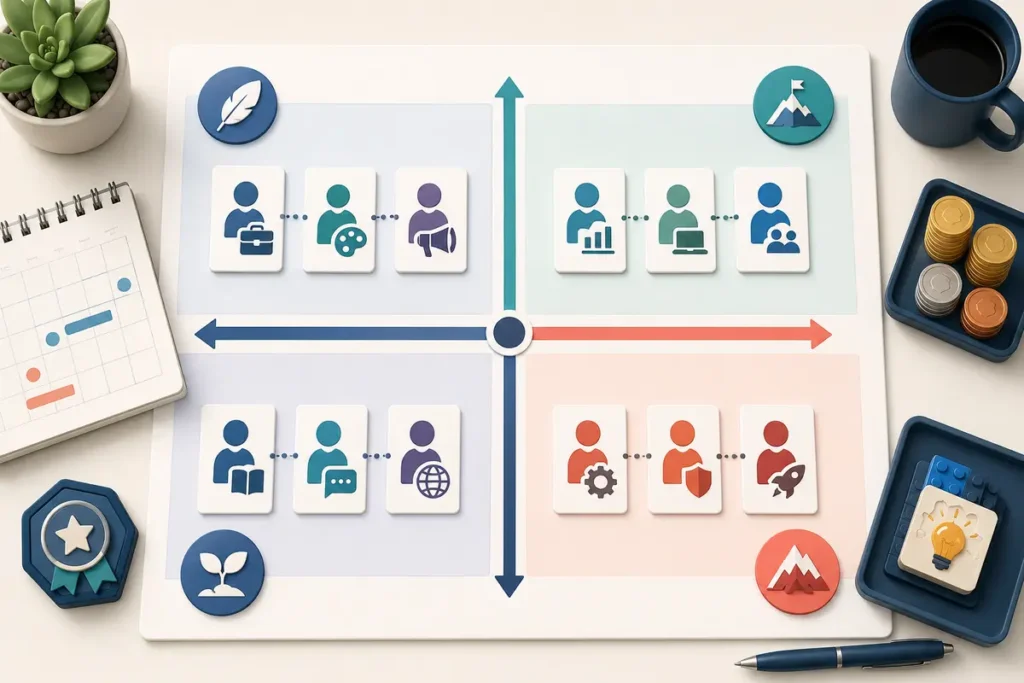
| Risk type | Examples | Recommended response |
|---|---|---|
| Low-cost and easy to reverse | Read occupation profiles, interview someone in the role, try a short project | Do these first to replace assumptions with evidence |
| Higher-cost but easy to reverse | Take a paid short course, reduce work hours for a trial, complete a certificate | Set a budget and a stop rule |
| Low-cost but hard to reverse | Publicly declining another path or waiting too long on an application deadline | Protect deadlines and keep options open |
| Higher-cost and hard to reverse | Large tuition commitment, relocation, long unpaid training or major debt | Require stronger evidence and a fallback plan |
For every major risk, add a safeguard. Before paying tuition, speak with recent graduates and employers. Before relocating, test the work locally or remotely. Before leaving income, calculate a minimum runway. The safest plan is not the one with zero uncertainty; it is the one in which the downside is understood and contained.
Five steps to move from fear to useful evidence
1. Name the exact fear
Write the feared outcome in one sentence: “I might dislike the daily tasks,” “I may not find work,” or “My family may disapprove.” A specific concern can be researched. A vague sense of doom cannot.
2. Separate facts from predictions
Create two columns. Put verified information—entry requirements, typical tasks, costs and deadlines—under facts. Put statements such as “I will fail” or “I will be trapped” under predictions. Research the predictions that can be checked and treat the rest as uncertainty, not truth.
3. Run the smallest realistic test
Choose an experiment that resembles the work. Complete a sample task, shadow a professional, volunteer, join a project, take one introductory module or ask a practitioner to describe a normal week. Watching inspirational videos is not the same as testing the work.

4. Record evidence, not just mood
After the test, note which tasks held your attention, which skills you wanted to improve, which conditions helped you perform and which trade-offs felt unacceptable. One difficult day is weak evidence; a repeated pattern across several experiences is stronger.
5. Choose the next commitment level
Decide whether to stop, test again or increase your commitment slightly. Move from conversation to project, from project to short course, or from short course to formal training. Each step should earn the next one.
A realistic example
Sam is deciding between user-experience design and business analysis. Instead of enrolling immediately in a costly programme, Sam reads detailed occupation profiles, interviews one person in each field and completes two small tasks: redesigning a confusing form and analysing a simple business process. The design task is enjoyable, but repeated visual revisions feel tiring. The analysis task is less exciting at first, yet Sam likes asking questions and organising evidence. Sam does not declare a lifelong winner. The next decision is to take a low-cost analysis course and join a four-week project while keeping the design option open. The risk is limited, the evidence is better and the review date is clear.
Remember: confidence often follows action; it does not always come before it. You do not need to feel fearless. You need a next step small enough to take and meaningful enough to teach you something.
Decide now, then reassess deliberately
Set a review date before you begin—perhaps two weeks after an interview round or one month after a project. At that review, ask: What did I learn about the tasks, environment, people, training and trade-offs? What evidence became stronger? What remains unknown? Then choose the next experiment. If anxiety is severe, persistent or affecting daily life, consider speaking with a qualified counsellor or mental-health professional alongside career guidance.
Continue with the cluster guides on choosing a career when you have no idea, using a career decision matrix and researching a career before choosing it.
Turn uncertainty into evidence. Take the RoleQuiz Study & Career Assessment to explore patterns worth testing. Use the result as a starting point, then compare it with occupation research, conversations and firsthand experience.
Sources and further reading
O*NET OnLine occupation research · National Career Development Association: career decision-making and mental health
Leave a Reply